
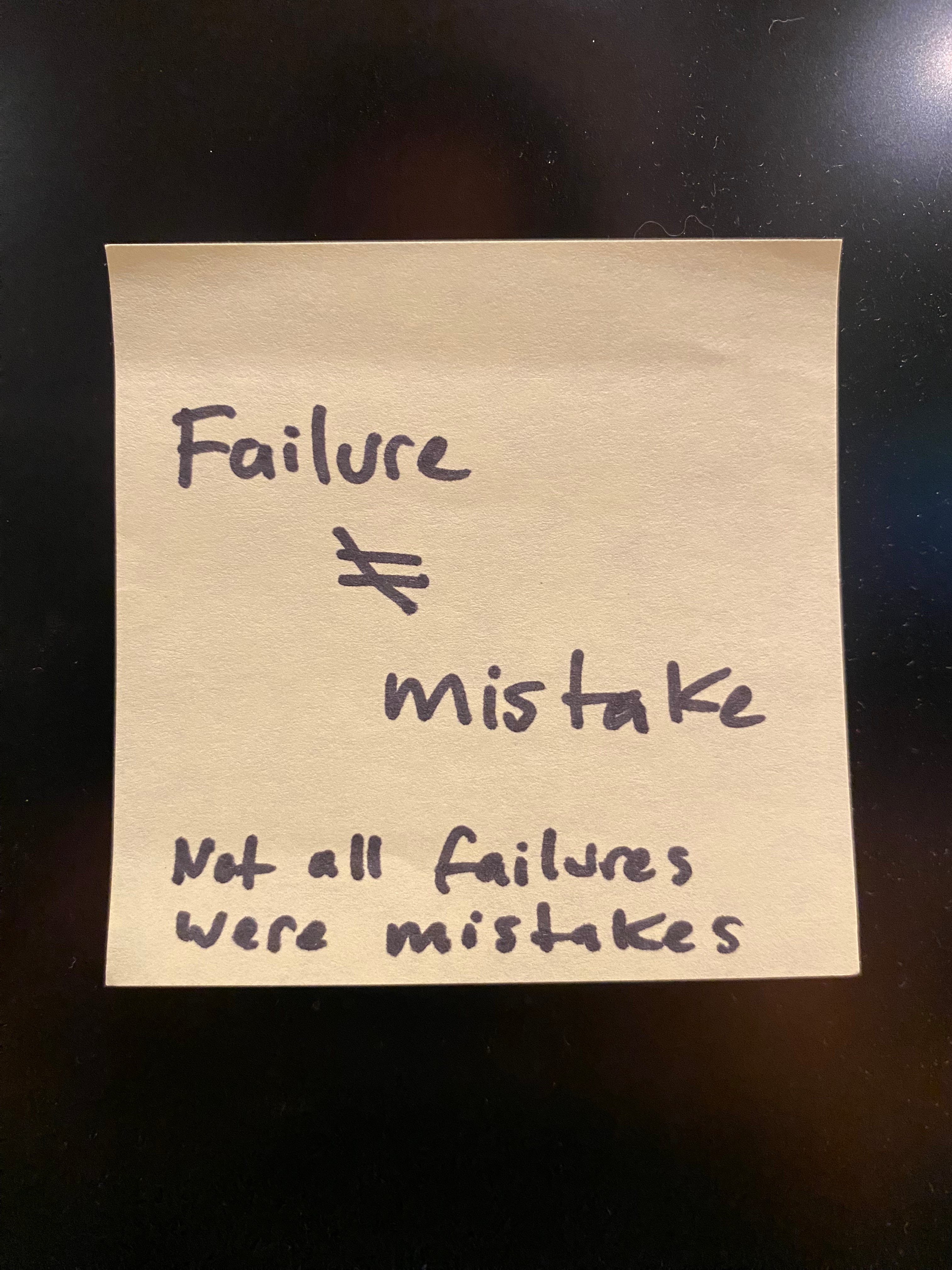
Failure ≠ mistake
Not all failures were mistakes (and vice versa)

Hi! While we’re on the topic of wrong, today’s sticky is:
Failure ≠ mistake. Not all failure were mistakes.
Why bother distinguishing between these words?
For one, language is meaningful and it’s useful to know the best word for the job. Not only do failure and mistake not mean the same thing, they are not even synonyms1.
Failure
as in negligence
the nonperformance of an assigned or expected actionas in defeat
a falling short of one's goalsas in disaster
something that has failedas in shortage
a falling short of an essential or desirable amount or numberas in bankruptcy
the inability to pay one's debts
Mistake
as in blunder
a wrong judgmentas in error
an unintentional departure from truth or accuracy
Grammarian tendencies aside, the concepts that these words represent can lead to blame and shame, two things I like to avoid because they are not kind. Don’t get me wrong, shame can be useful in motivating behavior, but it’s not beautiful, no compassionate.
I wrote this sticky as a talking point in a past situation where I felt that some folks (not everyone) were quick to blame others. If something failed, it was assumed that someone made a mistake, weren’t capable, had bad judgment, or were somehow at fault. Except that isn’t always true. Not every time something doesn’t go as planned/desired is because of human error, carelessness, stupidity, etc.
Side note: It’s also possible to make mistakes but still succeed.
We cannot always see, sense, or otherwise know why something failed or succeeded. But we want to know. We want to make sense, have reasons, and be certain about how the future will go.
I think it’s wise to examine our beliefs and the language we use. But sometimes we need a reminder. Hence all the sticky notes.
What do you think?
Love,
Kate